
Sciatica and disc injury care in Newport Beach
Pain that runs from the low back into the buttock, hamstring or calf usually means a nerve root is being irritated — commonly by a disc bulge or a restricted lumbar segment. Most cases resolve without surgery.
5.0 ★★★★★ 681 Google reviews · Two doctors · Forty years in Newport Beach
Your first visit is $97 — consultation, exam, HRV scan, X-rays if needed, and your first adjustment.
Why the pain travels
Sciatica is a description, not a diagnosis. It tells us a nerve root in the low back is irritated; it does not by itself tell us what is irritating it. The most common causes are a disc that has bulged and is contacting the nerve root, narrowing of the space the nerve exits through, and a lumbar segment that has stopped moving well and is loading the disc unevenly.
The distinguishing feature is that the pain travels in a line rather than spreading. It often follows a defined path down one leg, and it usually has movements that clearly worsen it — sitting for long periods, bending forward, coughing — and movements that clearly relieve it. That predictability is useful diagnostically, and it is the first thing we map out.
Pain that stays local to the low back is a different presentation and is covered on back and neck pain. Leg pain that began after a collision belongs on auto accident injury, where the documentation requirements differ.
What we examine
The examination establishes which nerve root is involved and how irritated it is. That means orthopaedic testing — straight leg raise and its variants — plus reflexes, muscle strength and sensation in the distribution the pain follows. We also test which directions of movement centralise the pain back toward the spine and which push it further down the leg, because that response guides treatment more than any single test.
This is one of the presentations where imaging is most often warranted, and X-rays are taken on site when the examination calls for them. Where findings suggest a significant disc lesion or where symptoms are progressing, we refer for MRI. The rest of the visit is described on what your first visit includes.
How we treat it
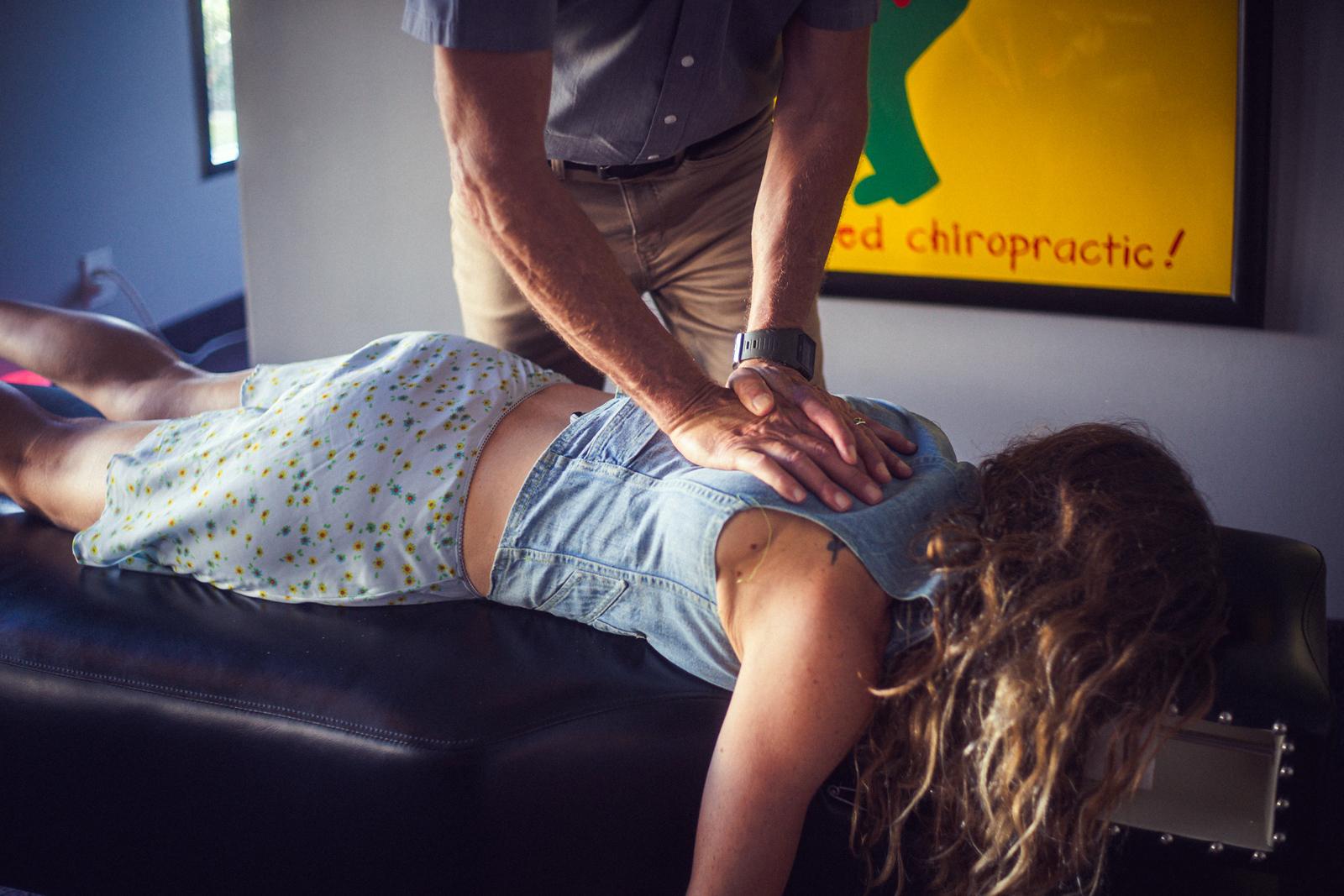
Non-surgical spinal decompression is the main tool for disc-related sciatica. It applies controlled, gradual axial traction to the lumbar spine, which lowers pressure inside the disc and reduces mechanical contact with the nerve root. Sessions are passive and painless; you lie on the table while the system cycles through a set programme.
Alongside decompression, specific adjusting restores motion to the segments above and below the involved level so the disc is loaded more evenly, and soft-tissue work addresses the compensations that build up in the hip and hamstring. These are listed under services.
Home loading matters more here than in almost any other presentation. You will be given a small number of positions and movements chosen for your direction of preference, and asked to avoid a small number of others — typically long unbroken sitting and loaded forward bending in the early weeks.
What recovery usually looks like
The first change most patients notice is not that the pain has gone but that it has moved: leg pain retreats toward the buttock and low back before it fades. That is the response we are looking for, and we track it explicitly from visit to visit.
Disc-related presentations generally take longer than simple mechanical back pain, and we will give you an honest estimate at the end of the first visit rather than an open-ended schedule. We re-examine at set points and compare against the baseline findings.
Adjusting hours are Monday and Wednesday 8—10am and 3—6pm, Tuesday and Thursday 3—6pm, and Friday 8—11am. If your symptoms are worsening between visits, tell us when you book so we can see you sooner.
When to seek care urgently
A small number of presentations need immediate medical assessment rather than conservative care. Loss of bladder or bowel control, numbness in the saddle region, or rapidly progressing weakness in a leg are red flags for cauda equina syndrome and warrant emergency assessment the same day.
Progressive foot drop, significant unexplained weight loss alongside back pain, or pain that follows major trauma also need medical evaluation first. Our examination screens for these, and if yours fits we will say so at the first visit and help you get to the right place rather than treating.
Sitting, driving and disc load
Pressure inside a lumbar disc is higher in unsupported sitting than in standing, and higher again in sitting with a forward lean — which is the position most desk work and most driving quietly enforce. This is why sciatica so often worsens across a working day and eases when people get up and walk.
The practical consequence is that treatment in the office competes with what happens in the other twenty-three hours. In the early weeks we usually ask for three changes: break up unbroken sitting at intervals rather than pushing through, set a lumbar support in the car and at the desk so the low back keeps its curve, and avoid loaded forward bending — the classic being lifting something out of a car boot with straight legs.
Walking is generally well tolerated and worth keeping, even when it is uncomfortable to start. Prolonged bed rest is not helpful for disc-related sciatica and tends to prolong recovery.
Related pages: back and neck pain where symptoms stay local, disc injury after a collision, and pelvic and leg pain during pregnancy, which presents similarly but is managed differently.
Is spinal decompression painful?
No. Decompression is a passive treatment: you lie on the table while controlled traction is applied and released in cycles. Most patients find it comfortable, and many find the leg pain eases during the session.
Do I need an MRI before I come in?
Not usually. We examine first and take X-rays on site if the examination warrants it. Where findings suggest a significant disc lesion or symptoms are progressing, we refer for MRI.
Will I need surgery?
Most sciatica resolves without it. We treat conservatively and re-examine at set points; if you are not responding, or if red-flag findings appear, we refer rather than continuing.
Do you take my insurance?
We accept Cigna, Blue Cross, United Health, Aetna, Coresource, Medicare, Optum and Coventry. Call (949) 250-0600 and we will check your benefits before you come in.
How long does the first appointment take?
About 45 minutes, covering consultation, exam, HRV scan, X-rays if needed and your first adjustment. Follow-ups take 10 to 15 minutes.
Claim a time.
Details after.
Rated by 681 patients on Google · 40 years in Newport Beach · Most insurance accepted