
Prenatal and pediatric chiropractic in Newport Beach
Care through pregnancy focuses on pelvic balance and the low-back load of a shifting centre of gravity. For infants and children the contact is light and sustained — nothing like an adult adjustment.
5.0 ★★★★★ 681 Google reviews · Two doctors · Forty years in Newport Beach
Your first visit is $97 — consultation, exam, HRV scan, X-rays if needed, and your first adjustment.
Care during pregnancy
Pregnancy changes the mechanics of the pelvis and low back over a short period. The centre of gravity moves forward, the lumbar curve deepens, and ligaments soften under the influence of relaxin, which allows the pelvis to accommodate but also reduces the passive stability the low back normally relies on.
The result, for many women, is low back pain, pelvic girdle pain around the pubic symphysis or sacroiliac joints, and difficulty turning in bed or standing on one leg to dress. These are mechanical problems, and they respond to mechanical care.
Technique changes considerably. We work in side posture and with a drop table rather than using rotational adjusting, and positioning is adapted at every stage so you are never lying face down on a flat table. Care can begin at any point in pregnancy and continues comfortably into the third trimester.
What we do and do not claim
We treat pain and mechanical restriction. Prenatal chiropractic care is well tolerated and commonly relieves pregnancy-related back and pelvic pain, and that is the basis on which we offer it.
We do not claim that adjusting shortens labour, turns a breech baby, or influences the course of a pregnancy. Where a specific obstetric question arises, it belongs with your obstetrician or midwife, and we are happy to work alongside them.
Every plan is discussed with you before it starts, and the first visit follows the same structure as any other: consultation, examination, HRV scan, imaging only where warranted — and imaging is avoided in pregnancy — and treatment.
Care for infants and children
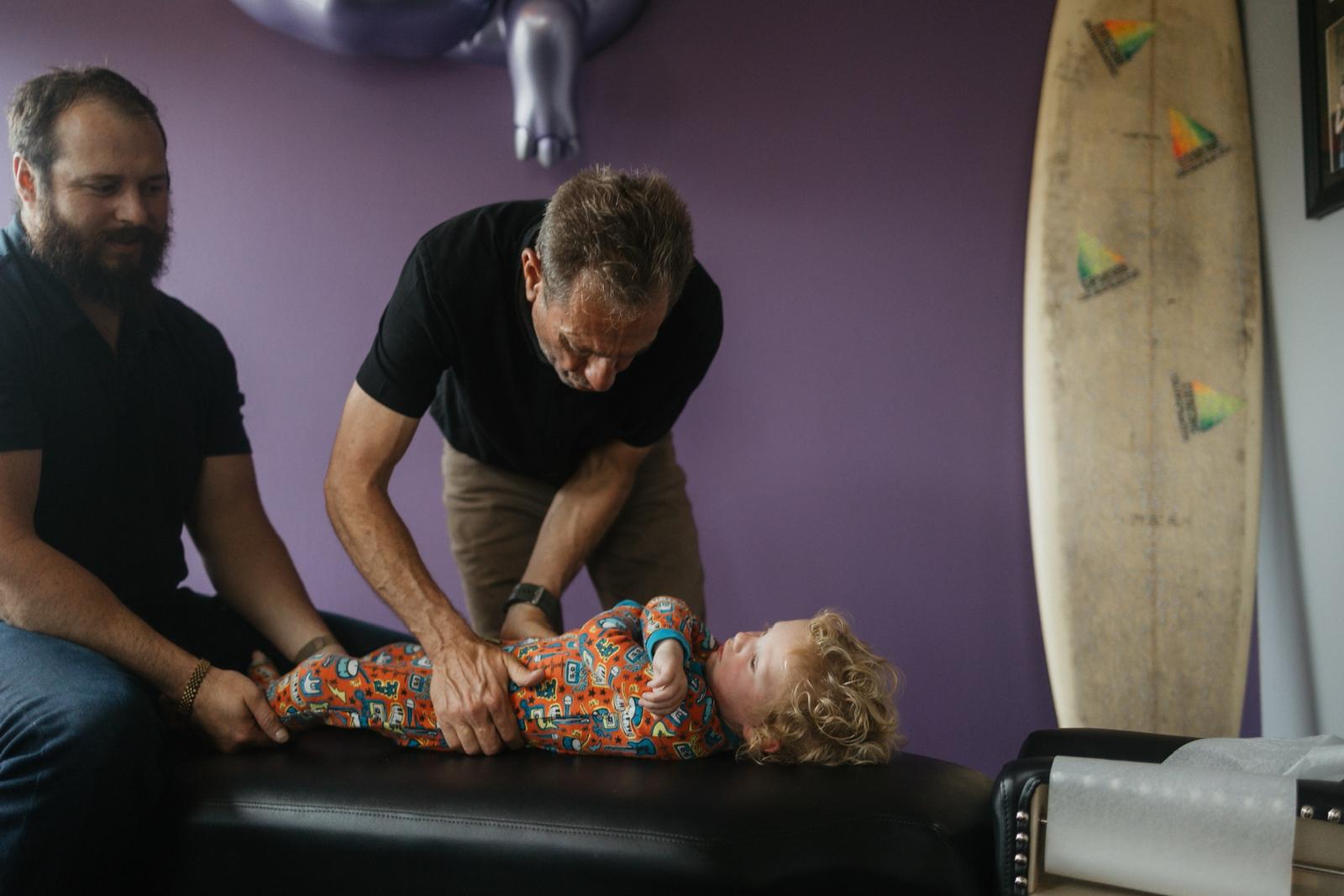
Pediatric adjusting bears very little resemblance to what an adult receives. The contact is light and sustained — roughly the pressure you would use to test the ripeness of a tomato — applied with a fingertip or a low-force instrument, and there is no manual thrust and no audible release.
Parents most often bring children in after a fall, for postural concerns as they grow, for sports-related complaints in older children, or on the recommendation of another parent. The examination is age-appropriate and unhurried, and much of a first pediatric visit is spent letting the child get comfortable in the room.
If a child presents with anything that suggests a medical rather than mechanical problem, we refer to their paediatrician. That is a routine part of the visit, not an exception.
What a family visit looks like here
Appointments run inside adjusting hours — Monday and Wednesday 8—10am and 3—6pm, Tuesday and Thursday 3—6pm, Friday 8—11am — and the afternoon blocks are usually easiest with children. Follow-ups take ten to fifteen minutes.
Intake forms are available in English and Spanish. Free surface parking sits directly outside the suite and the office is step-free from the lot, which matters more than you would expect at thirty-six weeks or with a pram.
Related pages if your own symptoms are the reason you are here: back and neck pain and sciatica and disc injuries, which is common late in pregnancy. Nutrition guidance is listed under services.
When to speak to your doctor first
During pregnancy, vaginal bleeding, leaking fluid, severe or persistent abdominal pain, reduced fetal movement, severe headache with visual changes, or swelling that comes on suddenly all need obstetric assessment rather than chiropractic care.
For infants and children, fever with irritability, a fall from height, a limb that will not be used, or any sudden change in feeding or alertness should go to a paediatrician or emergency department first. We screen for these at every visit and refer without hesitation.
After the birth
The mechanical demands do not stop at delivery, and the postnatal months are when many women first come in. The pelvis and abdominal wall are still recovering their stability while the daily load changes completely: feeding for long stretches in a chair that was not chosen for it, carrying a growing weight on one hip, lifting in and out of a cot with a long reach, and pushing a pram with the shoulders held high.
Neck and upper back pain is the most common presentation and is usually a straightforward feeding-posture problem. Low back and sacroiliac pain is next, and often responds quickly once pelvic motion is restored and the carrying habit is changed.
We do not put a timeline on when care can start — it depends on the birth and on how you are recovering — and we work alongside your obstetrician, midwife or pelvic floor physiotherapist rather than in place of them.
Related pages: back and neck pain, headaches from feeding posture, and sciatica and disc injuries if the pain travels into a leg.

Is chiropractic safe during pregnancy?
Prenatal chiropractic care is well tolerated and is commonly used for pregnancy-related back and pelvic pain. We use side-posture and drop-table technique rather than rotational adjusting, adapt positioning at every stage, and avoid imaging.
How is a child adjusted?
With light, sustained fingertip or low-force instrument contact — no manual thrust and no audible release. The pressure is comparable to what you would use to test a ripe tomato.
How young do you see children?
We see infants through to teenagers. Technique and examination are matched to age, and anything that looks medical rather than mechanical is referred to their paediatrician.
Do you take my insurance?
We accept Cigna, Blue Cross, United Health, Aetna, Coresource, Medicare, Optum and Coventry. Call (949) 250-0600 and we will check your benefits before you come in.
Where do I park?
There is free surface parking outside our suite at 20321 SW Birch St Ste 100, Newport Beach. The entrance is on the ground floor and the office is step-free from the lot.
Claim a time.
Details after.
Rated by 681 patients on Google · 40 years in Newport Beach · Most insurance accepted