
Knee Pain Treatment Newport Beach
What we assess
- The knee itself — joint line, kneecap, ligaments
- Hip control of rotation
- Ankle mobility
- How load is distributed on stairs and slopes
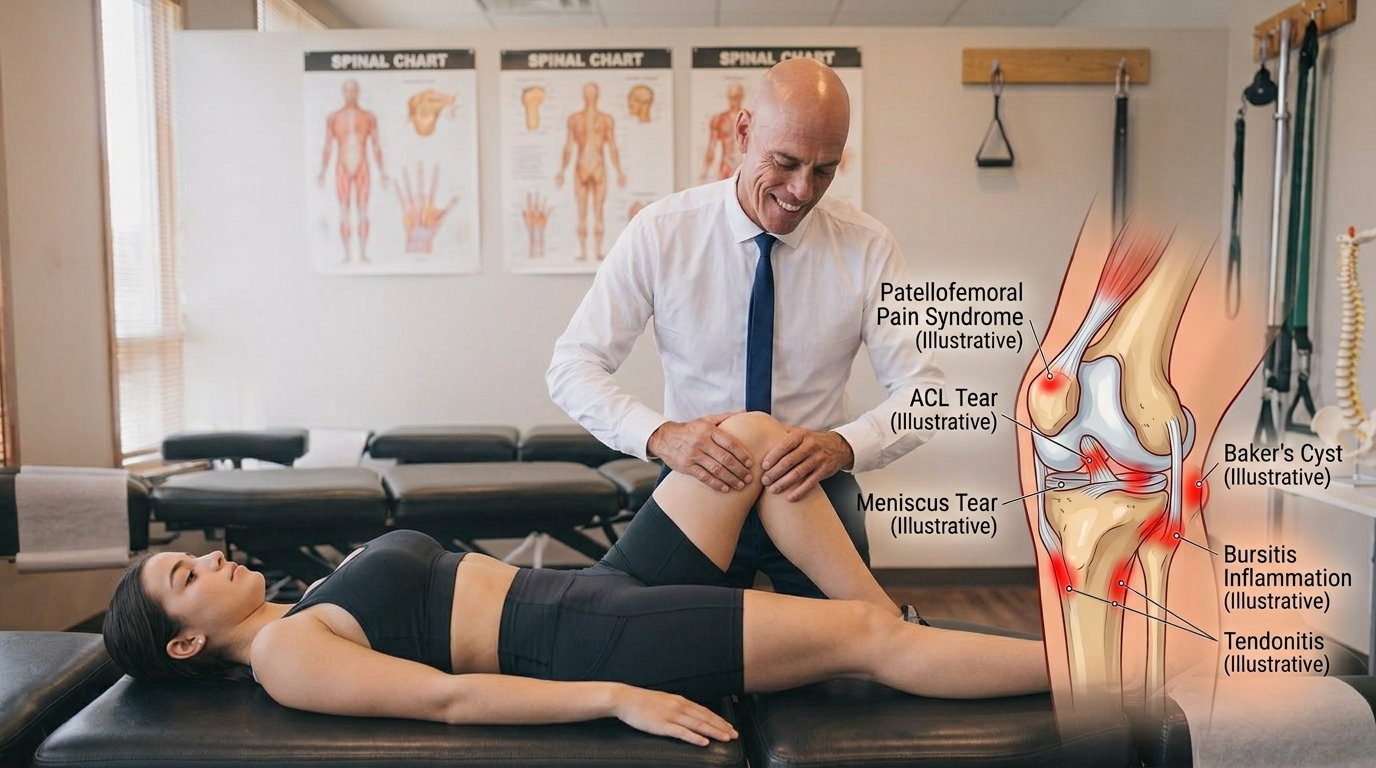
The knee is a simple hinge caught between two complicated joints. A great deal of knee pain is not a knee problem at all — it is a hip that has stopped controlling rotation, or a foot that has stopped absorbing load, and the knee taking the consequences.
How Knee Pain Treatment Newport Beach works
We examine the knee properly — the joint line, the kneecap and how it tracks, the ligaments and the meniscus — and then we look above and below. Knee Pain Treatment Newport Beach patients get here nearly always includes hip and ankle assessment, because that is where the driver usually is.
Pain at the front
The most common presentation, worse on stairs, after sitting, and going downhill. It is usually a load-distribution problem rather than damage, and it responds well to hip strength work, which surprises people who expected the treatment to be aimed at the knee.
The joints either side
A hip that cannot control inward rotation lets the knee collapse inward on every step, and a stiff ankle forces the knee forward to compensate. Treat the knee alone and you get temporary relief; address the driver and it holds.
What needs more than us
A knee that locks, gives way repeatedly, or swelled up within an hour of an injury needs imaging and an orthopaedic opinion. So does a knee that is hot and swollen without an injury, which can be infection or inflammatory arthritis.
Stairs, hills and what they tell us
Pain going downstairs and downhill points at the front of the knee and load control. Pain going up points more often at strength. Pain that is worse after sitting for a long period and eases once you get going is the classic pattern for kneecap-related pain. We will ask about all three, because the answers narrow the problem faster than any single test does.